
The Chapel School, a multi-denominational church built in 1771 at the Old Parish Burying Ground, served as a school on weekdays, and was certainly the first “public school” in Windsor. The Curren School was the second. Thomas Curren taught at King’s Collegiate for twenty-five years from 1821 to 1846. When he retired, he opened a school in a small building next to his home on King Street, just beyond its junction with O’Brien Street. He was a splendid teacher and had many young students. The school building was then situated level with the sidewalk, as shown here. It was of fine construction, with plastered walls, and was well suited as a school.
Thomas Curren (1805-1876)
He matriculated from King’s College Academy, Windsor, in 1825. He taught at the Academy ca. 1826 to 1846, leaving in July that year along with the headmaster, Rev. William Burgess King, who may have helped him in setting up his own school next year. The Curren school, conducted by Thomas and his younger brother Benjamin, continued from 1 Feb. 1847 to July 1859. Many citizens of Windsor, boys and girls, from all walks of life, were educated there. Sometimes the Currens were paid by patrons with no children of their own, and sometimes the students were educated for free. (Information gleaned from the account book mentioned above.) On the returns for the school for 1857 and 1858 by Benjamin Curren, Thomas Curren is listed as trustee. On the 1857 returns, John Jurdan is also a trustee. Thomas Curren was appointed coroner for Hants County, 29 Sept. 1863. (PANS: RG3,Vol.l, 174).
Benjamin Curren (1826-1889)
Born in Windsor, 1826, died in Halifax, 31 March, 1889 and is buried at Camp Hill Cemetery. Benjamin Curren was matriculated from King’s College Academy in 1843; B.A. from King’s College, 1847; M.A., King’s, 1859; B,C.L., King’s, 1864; D.C.L., King’s, 1864. Grand Secretary of the Grand Lodge of Nova Scotia nineteen years. He appears to have come out of King’s with his B.A. and assisted his older brother Thomas James Curren in the operation of the school in Windsor, which he took over in 1850 and continued operating until 1859. By early August 1859, he was living in Halifax, when he and his wife sold some of his late father-in-law’s property in Windsor to James Peter Pellow. (Windsor, Registry of Deeds, Book 41, p. 134). Selections from the Public Documents of the Province of Nova Scotia edited by Thomas Beamish Akins, Halifax, 1869, bears also the credit: “The translations from the French by Benj. Curren, D. C. L.”
In Windsor he taught music, French, German, and many other subjects, including violin, and tuned pianos. He was president of the Alumni Association of King’s College, and from about 1859 to 1868 a member of the Board of the University. His term as school commissioner in Halifax may have been about 1877-78. Wikitree reference
Curren Name
Neither Curren (Curran) nor Kern appears as a surname in the Halifax census of 1752, nor do these surnames appear in the Nova Scotia census returns for the period 1770-1773.
But in the records of St. Paul’s Church, Halifax, for the period 1749-1768, there are three entries. Stephen and Eleanor Curren had a daughter Mary baptised 27 Oct. 1751, and a son Stephen baptised in June, 1755. The third entry is the death of Stephen Curren in November, 1756. The entry does not clarify whether this was the father or the son, but child mortality being what it was, the odds are on the son having died. There is no discovered evidence of connection between this Curren family and several later Currens who were evidently Loyalist refugees.
In most deeds and documents of the Windsor Curren family, including those Signed by them, the spelling is given as Curren. The spelling Curran occurs in the article about the “Curran house” on King Street, published in Seasoned Timbers (Heritage Trust of Nova Scotia), and largely repeated in The Hants Journal, Windsor, 26 Aug. 1987, p. 13. Information for both of these pieces is based largely on undocumented notes by Gwendolyn V. Shand, which, along with two sets of notes on the Currens deposited by her in the Public Archives of Nova Scotia, are, unfortunately, unreliable.
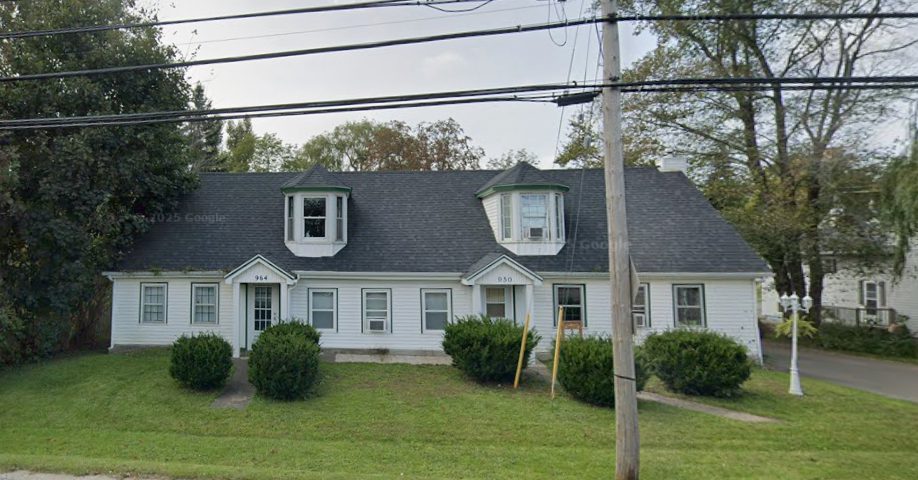
Curren House
The Cape Cod house on King Street – known to many as the Curren House – was, in the old coaching days, an inn conducted by Leonard Geldert. Mr. Geldert was an excellent horseman and a story-teller of some note. It has even been said that Judge Thomas Haliburton used some of those stories to enliven his writing and a number of the incidents one finds in the Sam Slick books were first told by Mr. Geldert. Later the long frame house became the home of Benjamin Curren from whom the house still takes its name. For over twenty years, beginning in 1847, Dr. Benjamin Curren ran a day school in Windsor. Before the introduction of free schools into Windsor in 1866, there were many educational institutions in the town. The county was divided into districts, each with its own schoolhouse. In 1831 the Windsor Town Plot school in district one was attended by eighty scholars, eleven of whom were taught for free or granted scholarships.
Dr. Benjamin Curren school served for over twenty years as a day school for Windsor children from the ages of six to fifteen. Seventy-nine boys and girls attended. Dr. Curren had been Supervisor of Schools in Halifax and the excellence of his teaching soon became a tradition in Windsor. Thomas Curren, his brother, assisted him. Evening classes were also held here as well, as classes in music – including vocal lessons – and the excellence of the teaching there became a tradition in the Windsor area. Although the school itself was closed in the 1860’s, Thomas Curren, had three children – John, Fred, and Minnie who carried on the tradition of the home as a cultural centre. During World War I they opened up their home to soldiers stationed in Windsor, and the home remained a haven for music lovers.
Following the death of Fred Curren, Thomas Curren’s oldest surviving son, the house was sold to Mr. John Kuhn and then to Mr. Clayton Joudrey. Two large elms guard the front of the older home, shading its twin dormers and lending additional charm to its New England exterior. [Gateway to the Valley]