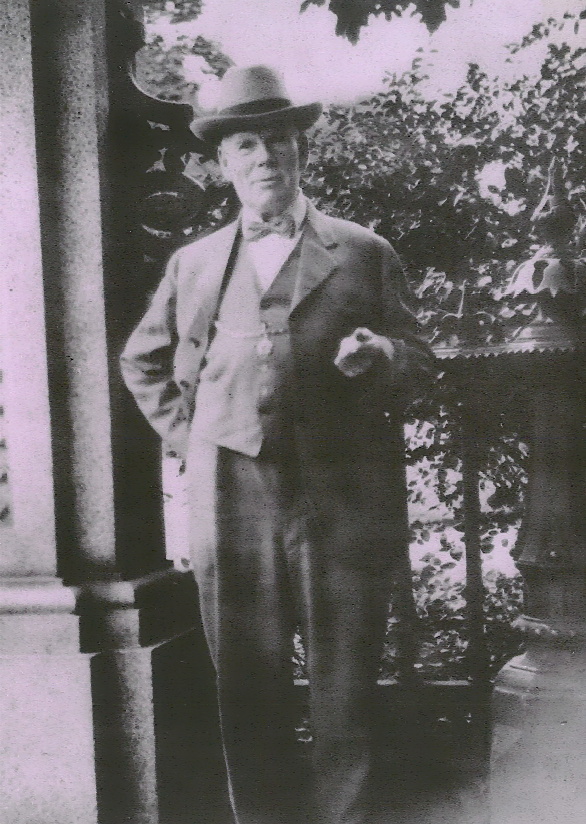
George R. Wiley was born about 1868 and died at Windsor on April 27, 1944. He was the son of Captain James Wiley, a sea captain who was lost in the Barbados in 1885. His mother Frances Elisabeth was born in Cork, Ireland and after Capt. Wiley’s death she married John A. Calder of Windsor. Mrs. Calder was of Windsor’s early teachers of pianoforte. She died on Jan. 7th, 1926.
George R. Wiley was a druggist in Dorchester, Mass.
In 1919, he retired to Windsor with his wife and had a home on Elm Street (now 150 Chestnut Street). He was a prominent citizen and enjoyed daily walks about the town. He fell into ill health in his later years and died in 1944. In his will George Wiley left a large sum of money to various churches and charities in town as well as a large sum to the Town of Windsor to help with the construction of the Community Center.
Wiley Avenue was constructed in 1956 and named in honor of George R Wiley. It originally ran from Albert Street to King Street. Plunket Street was the original name of the lower portion between Victoria and Albert streets.
A Tribute to Mr. George Wiley
by Garth Vaughan (circa 1990)
We have a natural tendency to come to accept certain people, places, things and events as commonplace. They are soon taken for granted. Most are then ignored and many become forgotten. For instance, a very important street in Windsor serves to expedite travel through town, by avoiding busy traffic areas. It was carefully planned and carved out of “Cow Hill” to join Plunkett Street, across Chapel Lane (Albert Street), with King Street at Curry’s Corner. When it was constructed in the 1950s, the town council decided to name it after a respected citizen who had died recently. His name was Mr. George Wiley and the street was to be called “Wiley Avenue”.
Mr. Wiley had been an old fashioned apothecary/druggist with a shop at the corner of Water and Gerrish Streets. He had played a very important part in the health of regional people at the turn of the century. He was a fine gentleman who frequently was seen walking the streets of Windsor for exercise in his latter years, the 1940-50s. He had some distinguishing features. He carried a shiny walking stick, and might be called ‘dapper’. He was an immaculate dresser and usually wore a Homburg hat, tailored three-piece suit with a gold-chain and watch fob, polished shoes, and a welcoming smile. He gave the appearance of being very content with life and those around him. He lived in a large house on Chestnut Street and was alone in the house in his final years. What he did with his time when not walking isn’t exactly known. The fact that he left money in his will to ensure that the people of the area would have a library in the new Hants County World War II Memorial Community Centre suggests that he might have spent wonderful leisure hours of contentment, reading books.
The library for which he was responsible served the population of West Hants from that time to this. Somebody had thought to place a nice photo of him on the library wall. However, it was hung high over the book shelves, above eye level, where few would notice it. No name or plaque was assigned to accompany it. At first, some town’s people would have known who he was, but as time went by, people didn’t even bother to ask whose photo it was. It would be pretty certain that such a fine philanthropic gentleman would not be looking for eternal recognition for his act of public kindness.
Recently, when the library was emptied of its books as they were moved to the splendid new Regional Library on Albert Street, the old book shelves were left behind. As I stepped into the vacant room a few days ago to reminisce about an era past, I noticed an old gold picture frame resting on a top shelf. Turning it over it was a little disturbing to learn that time had marched on and left Mr. Wiley and his photo behind, face down and dusty. Like so many other people and things, he had been taken for granted all those years and now was being ignored and, perhaps, might soon be forgotten.